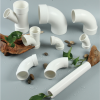
What is PPR pipe material
PPR is the abbreviation for Type III polypropylene, also known as random copolymer polypropylene pipe. It adopts hot melt welding method and has specialized welding and cutting tools, with high plasticity. The price is also very economical. By adding an insulation layer, the insulation performance is better, and the pipe wall is also very smooth, excluding the joints of the inner and outer wires. Generally used for embedded walls or deep well pre embedded pipes. PPR pipes are moderately priced, stable in performance, heat-resistant and corrosion-resistant, with smooth and non scaling inner walls. The pipeline system is safe and reliable, and does not penetrate, with a service life of up to 50 years. But the construction technology requires high standards, and specialized tools and professionals need to be used for construction to ensure system safety.
Compared with traditional cast iron pipes, galvanized steel pipes, cement pipes and other pipelines, PPR pipes have the advantages of energy saving, material saving, environmental protection, lightweight and high-strength, corrosion resistance, smooth inner wall without scaling, easy construction and maintenance, and long service life. They are widely used in building water supply and drainage, urban and rural water supply and drainage, urban gas, power and optical cable sheaths, industrial fluid transportation, agricultural irrigation and other construction, municipal, industrial and agricultural fields.
In recent years, with the increasing market demand in industries such as construction, municipal engineering, water conservancy engineering, agriculture, and industry, China's PPR pipe industry has shown a rapid development trend. In 2009, the production of plastic pipes was 5.804 million tons, a year-on-year increase of 18.9%. From January to September 2010, the production of plastic pipes was 5.528 million tons, a year-on-year increase of 28.23%. At the same time, with the continuous improvement of consumers' quality requirements for product environmental protection, health, durability, and other aspects, the production of plastic pipes in China has increased, and the quality level of products has been continuously improved. The technological progress of the industry has been accelerating, the number of brand scale enterprises has been increasing, new materials and structural varieties have emerged, and advanced system design concepts have emerged one after another. The functionality of products has become more obvious, and the application fields have been further expanded. Analysis suggests that the market share of plastic pipes in China exceeded 30% among all pipes in 2013.
By 2015, in new construction, renovation, and expansion projects nationwide, 85% of building drainage pipes will use plastic pipes, 80% of building rainwater drainage pipes will use plastic pipes, 50% of urban drainage pipes will use plastic pipes, 85% of building water supply, hot water supply, and heating pipes will use plastic pipes, 80% of urban water supply pipes (below DN400mm) will use plastic pipes, 90% of rural water supply pipes will use plastic pipes, the application of plastic pipes (medium and low pressure pipes) for urban gas will reach 40%, and 90% of building wire conduit sleeves will use plastic pipes. It is predicted that the production of plastic pipes in China will maintain a growth rate of around 10% during the 12th Five Year Plan period. By 2015, it is expected that the national production of plastic pipes will approach 12 million tons, and the market share of plastic pipes in various types of pipes in the country will exceed 60%.

PPR pipe specifications are represented by pipe series S, nominal outer diameter dn x nominal wall thickness en
Example: PPR pipe series S5, PPR nominal outer diameter dn25mm, PPR nominal wall thickness en2.5mm
Expressed as S5, dn25 × en2.5mm
PPR pipe series S: It is a dimensionless numerical series used to represent the specifications of PPR pipes, with the following relationship S=(dn en)/2 en
Among them: dn - PPR nominal diameter (outer diameter), unit: mm
En - PPR nominal wall thickness, in millimeters
The commonly used PP-R pipe specifications include five series: 5, 4, 3.2, 2.5, and 2
PPR pipe specifications are divided into five series according to the standard size ratio SDR value: 11, 9, 7.4, 6, and 5.
PPR pipe specification PPR standard size ratio SDR: The ratio of the nominal outer diameter dn to the nominal wall thickness en of PPR pipes.
The relationship between PPR pipe specification SDR and PPR pipe series is as follows: SDR=2S+1
Representation method for PPR pipe fittings specifications:
The nominal outer diameter dn of PPR fittings refers to the nominal outer diameter of PPR pipes connected to PPR fittings. The wall thickness of PPR fittings should not be less than that of PPR pipes of the same PPR pipe series S.
Most enterprise PPR fittings only have the highest standard S2 series, which is suitable for both hot and cold water
PPR Pipe Specification S5 Series
PPR Pipe Specification S4 Series
PPR Pipe Specification S3.2 Series -2.0 megapascals (20 kilograms)
PPR pipe specification S2.5 series -2.5 megapascals (25 kilograms)

What is UPVC pipe material
UPVC pipes are a type of plastic pi...
PVC pipe drainage fittings
UPVC pipes are a type of plastic pi...Navigation
- PVC Pipe & Fittings
- PVC Resin
- Molds Manufacturing
- Customizing Products
- Plastic Drainage Channel
- PRR Pipes & Fittings
Blog
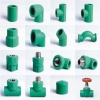
What is PPR pipe material
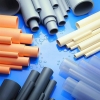
What is UPVC pipe material