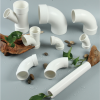
What is UPVC pipe material
UPVC pipes are a type of plastic pipe mainly used in water piping engineering. The product is carried by polyvinyl chloride resin and has excellent characteristics such as accurate temperature sensing, timed melting, and rapid absorption of effective ingredients of additives when reducing the attraction between resin molecular chains. At the same time, it uses world-renowned calcium zinc composite heat stabilizers to capture, inhibit, absorb and neutralize the release of hydrogen chloride during the high temperature and melting process of the resin. It undergoes double bond addition reaction with the polyolefin structure, replacing active and unstable chlorine atoms in the molecules. Thereby effectively and scientifically controlling the catalytic degradation and oxidative decomposition of resin in a molten state.
UPVC pipe is a plastic pipe made from polyvinyl chloride (PVC) resin without plasticizers. With the development of chemical industry technology, non-toxic grade pipes can now be produced, which have the properties of general polyvinyl chloride and some excellent properties. Specifically, it has the advantages of corrosion resistance and flexibility, making it particularly suitable for water supply networks. Due to its non-conductive nature, it is not easily subjected to electrochemical reactions with acids, bases, and salts, making it difficult for them to corrode. Therefore, there is no need for an external anti-corrosion coating or inner lining. And its good flexibility overcomes the brittleness of plastic pipes in the past, allowing them to yield under load without breaking. I once conducted an experiment where a DN50mm UPVC pipe was placed on the ground and a Crown 3.0 car was driven on it. The pipe was only flattened, but not broken. Then we had the Dongfeng truck loaded with goods pass over the pipe, and the pipe only deformed without breaking. In addition, UPVC pipes have a smaller elastic modulus, which can reduce the amplitude of pressure impact and alleviate the impact force of water hammer. The inner wall of the U-PVC pipe is smooth and has low resistance (the resistance coefficient of UPVC pipe is 0.009, while that of general galvanized pipe). The resistance coefficient of cast iron pipes is 0.012-0.013, so it is obvious that the hydraulic conditions are good. When using pipes of the same diameter to transport the same liquid, the resistance of UPVC pipes is about 30% lower than that of galvanized pipes and cast iron pipes; When the head loss is the same, the water carrying capacity of UPVC pipes is more than 20% greater than that of cast iron pipes. Due to the smooth inner wall of the UPVC pipe, the liquid flowing inside will not scale, so its conveying capacity will not decrease with the increase of operating time. And this is precisely the insurmountable disadvantage of galvanized pipes and cast iron pipes. With the continuous deepening of reform and opening up, people's living standards are constantly improving, and the requirements for the quality of tap water are also increasing. In addition to ensuring that the produced water meets the standards for drinking water, the water supply industry must also ensure that the water transported through the pipeline network is qualified. People have strong reactions to phenomena such as "yellow water" and "black water" in tap water, and the main reason for the deterioration of water quality in the pipeline network is the corrosion of water supply pipelines, especially cold galvanized pipes. The coating on the inner wall of the pipes is unstable, and the pipes start to rust after a year or so of use, causing an iron smell and color in the water. The corrosion of galvanized pipes buried underground is even more serious. And UPVC pipes are corrosion-resistant. Not scaling, can inhibit bacterial growth, and is beneficial for protecting water quality from secondary pollution of pipelines. So UPVC pipes have a wide range of application prospects, especially for a large number of buried pipes in front of users' water meters.
In addition, UPVC pipes are also lightweight. The advantage of convenient transportation. The specific gravity of UPVC pipe is about 1.4 (the specific gravity of cast iron pipe is about 7.4), which is one-fifth of the weight of cast iron pipe. Using UPVC pipe can save 1/10-1/5 of transportation costs compared to cast iron pipe. It is very convenient for handling, loading and unloading construction. The construction environment for water supply pipelines is often harsh, and the construction site is muddy. It would be ideal to reduce the labor intensity of workers and shorten the construction period. And using UPVC pipes can achieve this ideal. UPVC pipes are lightweight and can be manually moved during installation, generally without the need for machinery. For example, a DN200 6m long UPVC pipe weighs about 55kg, while a cast iron pipe of the same diameter and length weighs 304kg. During installation, one person can carry the UPVC pipe, while the cast iron pipe requires three people or machinery to be lowered. This greatly reduces the labor intensity of workers and saves time and construction costs.
The connection methods of UPVC pipes include socket rubber ring connection, adhesive connection, and flange connection. These connection forms do not require digging a separate work pit and can be installed directly in the pipe trench. There is no need to use oil hemp or expanded cement to make joints. A manual hoist or a rubber ring can be used to insert the pipe socket end directly into the socket, and the depth of insertion can be determined by the marking at the end of the pipe.

UPVC pipe and PE pipe are both thermoplastic pipes, and they have a common characteristic, but in terms of elasticity. Heat resistance requirements. There are also differences in anti-aging and other technical characteristics. The technical characteristics of UPVC pipes and PE pipes are compared and analyzed as follows:
1. Performance comparison between UPVC and PE pipes
The advantages and disadvantages of different types of pipes are that UPVC has strong corrosion resistance, is easy to connect, is inexpensive, and has a hard texture. Not suitable for hot water transportation, with high requirements for joint bonding technology and long curing time. HDPE is lightweight, with good fatigue strength, temperature resistance, toughness, and flexibility. Welding requires electricity; Mechanical connectors are relatively expensive.
From the above table, it can be seen that PE pipes are limited and hindered in their widespread application due to the expensive cost of their connecting joints.
2. Linear expansion coefficient of UPVC and PE pipes
Pipe expansion coefficient a (/0C) UPVC (rigid polyvinyl chloride) 6 × 10⁻⁵ HDPE (high-density polyvinyl chloride) 18 × 10-5 MDPE (low-density polyvinyl chloride) 16 × 10-5
From this, it can be seen that PE pipes have a larger coefficient of linear expansion than UPVC pipes, so it should be taken seriously in the design.
Comparison of aging resistance performance of UPVC pipes
The comprehensive evaluation of PVC.PE pipes by developed countries is as follows:
Content evaluation value PVC HDPE MDPE aging resistance value 20 13
From the above table, it can be seen that PVC pipes are superior to PE pipes in terms of aging resistance and long-term strength; From the perspective of damage form, PE is superior to PVC. As for the ease of rolling and welding, it only depends on the installation process. Transportation and other related factors should not be used as the main indicators for evaluating the two materials.
4. Installation and connection form of UPVC pipe and PE pipe
As mentioned earlier, the connection method of UPVC pipes includes socket rubber ring connection. For adhesive and flange connections, it is more suitable to use socket rubber rings for larger pipe diameters. If adhesive connection is used during construction, it is difficult to ensure absolute cleanliness of the pipe joint before bonding, and a grain of mud and sand. A small bubble can be a hidden danger of interface leakage. In addition, bonding is also affected by temperature and air conditions, making outdoor construction somewhat difficult.
The connection forms of PE pipes include electric melting connection and hot melting butt connection. Especially for electric fusion connection, it uses a sleeve to cover the interface between two pipes, and heats the sleeve and two pipes together through the electric heating wire inside the sleeve. The process is easy to achieve and ensure that the interface is dense and leak free, but this sleeve type joint is expensive.

Navigation
- PVC Pipe & Fittings
- PVC Resin
- Molds Manufacturing
- Customizing Products
- Plastic Drainage Channel
- PRR Pipes & Fittings
Blog
What is PPR pipe material
What is UPVC pipe material